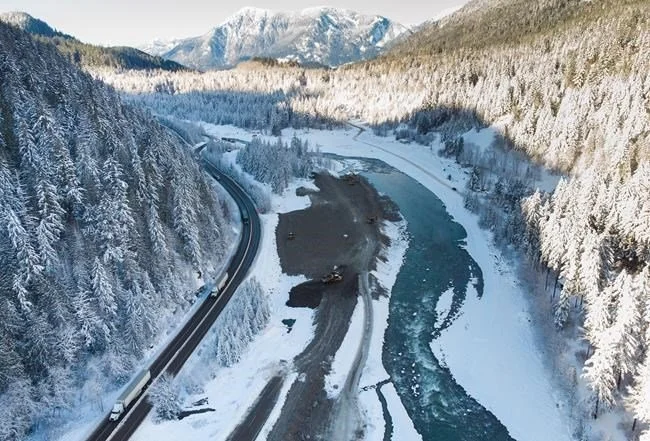
Members of a First Nation in British Columbia who were forced from their home more than 90 days ago when a nearby river changed course during catastrophic floods are now allowed to return. Chief Arnie Lampreau of the Shackan Indian Band said he never expected community members would be off their reserve in the Nicola Valley for so long. "They're excited to come home,'' he said in an interview.
Environment Canada links B.C. floods to human-induced climate change
Human-induced climate change “contributed substantially” to the atmospheric river and ensuing floods that devastated B.C. last year, a new study by Environment Canada scientists confirms, warning Canadians to brace for more of the same. “The chance this kind of flood will happen has increased by 100 to 300 per cent due to human influence,” Xuebin Zhang, a senior research scientist with Environment and Climate Change Canada, told Canada’s National Observer.
B.C. flouting Canadian, international standards on protected areas, says report
The B.C. government claims it protects nearly 20 per cent of the province's land base as sanctuaries for biodiversity, but a new report says it has abused a key designation to “falsely inflate” its progress. The report, which was jointly produced between the environmental law group Ecojustice and the B.C. chapter of the Canadian Parks and Wilderness Society, examined Old Growth Management Areas, Wildlife Habitat Areas, and Wildland Zones. Together, they account for nearly all of what the province claims as “other conserved” areas, a designation B.C. uses more than any other province in Canada.
N.W.T. has no extra money to assist Behchokǫ̀ with failing water infrastructure
The N.W.T. government says the Behchokǫ̀ community government, which includes Rae, Edzo and Frank Channel, is responsible for budgeting major repairs to its deteriorating water infrastructure. That's after residents in Edzo went weeks with brown water coming from their taps, or none at all. "This is a municipal government issue," said Municipal and Community Affairs Minister Shane Thompson.
Thawing permafrost can expose northerners to cancer-causing gas, study says
Thawing permafrost might be exposing people in northern Canada to higher levels of a naturally-occurring gas that causes lung cancer, says a new study out of the U.K. Paul Glover, the study's lead researcher, said permafrost has been acting as a "hidden guardian" by keeping radon locked in the ground in the circumpolar Arctic and preventing it from travelling to the Earth's surface and accumulating in buildings.
Salmon Arm looks to borrow $2.3 million for ‘essential’ water infrastructure project
The City of Salmon Arm will be looking for voter approval to borrow more than $2 million for one of two water infrastructure projects deemed essential by city council. At its Monday, Feb. 12 meeting, council voted to support a loan authorization bylaw enabling the city to proceed towards an alternate approval process, through which voter assent will be sought to borrow $2,298,000 for the construction of a replacement to the Zone 5 booster (water pumping) station.
Researchers to Study the Winter Mysteries of the Great Lakes Ecosystem
Dozens of researchers from across Canada and the U.S. are embarking on a first-of-its-kind study in the Great Lakes region this week to uncover the mysteries of what lies beneath the surface during the winter months. The event dubbed the “Winter Grab” involves bi-national scientists from several institutions including the University of Windsor to fill the knowledge gaps of what takes place in the largest source of fresh water in the world year-round.
Study suggests climate change made B.C. floods at least twice as likely
Catastrophic floods that swamped much of southern British Columbia last fall were at least twice as likely because of climate change, suggests new research from Environment Canada. The study, now undergoing peer review, concludes that the likelihood of similar events in the future will only increase as global warming continues to upend normal weather patterns. "We do find substantial ongoing increases in the probability of these kinds of events," said Nathan Gillett, an atmospheric physicist and manager of the Canadian Centre for Climate Modelling and Analysis.
Flooding cuts 8.2% off average Canadian home sale prices, says study
Flooding in Canada experienced in the last decade cut an average of 8.2 per cent off the sale price of homes in several markets, says a new study. The Intact Centre on Climate Adaptation at the University of Waterloo studied several floods that occurred between 2009 and 2020 in Grand Forks in British Columbia; Burlington, Toronto and Ottawa in Ontario; and Gatineau in Quebec. Data suggests that houses selling last December for an average price of $713,500 would instead go for $654,993, once hit by a flood, reflecting a loss of $58,507, says the study that was partially funded in part by Canada Mortgage and Housing Corp.
Megadrought in Southwest US worst in a millennium
The American West is experiencing its worst drought since 800AD - around the time Charlemagne ruled - according to a newly released study. The ongoing drought has seen lakes, reservoirs and rivers in California fall to record lows, exacerbating wildfires, according to scientists. The current drought is the worst 22-year dry period in the last 1,200 years - dating back to Vikings and Mayans.
Wawanesa Helps Homeowners Prevent Common Water Losses
The Wawanesa Mutual Insurance Company (Wawanesa) has launched “Save the Stress” – a campaign aimed at helping Canadian homeowners reduce the frequency and severity of common water losses. The campaign features free videos and blog content about four main topics: sump pump basics, washing machine hoses, hot water tank maintenance, and water leakage detection technology.
Messy weather coming with ice, rain and snow – and warnings about runoff
Weather forecasters warn a “messy mix of wintry precipitation,” including freezing rain and ice pellets, is set to move into Southwestern Ontario. In a special weather statement, Environment Canada says up to 25 millimetres of rain could fall between late Wednesday and Thursday afternoon. The federal weather agency is calling for a high in London of 7 C on Wednesday and 2 C Thursday.
Feds bow to industry, provincial lobbying and weaken proposed coal rules
The federal government has bowed to provincial and industry lobbying in weakening proposed standards for coal mining effluent, critics say. A discussion document for draft regulations, released earlier this year, would double the amount of toxins — such as selenium — the mines are allowed to release and wouldn't apply to any mine that starts producing before 2027. Nor do they require companies to monitor overall environmental effects.
New private member’s bill could help communities survive the climate crisis
Last year, Canadians were battered by wildfires, heat waves and floods, but a new private member’s bill aims to help communities weather the climate crisis. On Feb. 8, NDP MP Niki Ashton tabled a bill that would instruct the Canada Infrastructure Bank to prioritize projects that help the country adapt to or mitigate the effects of climate change. It would also require the bank’s board to have at least three members recommended by Indigenous organizations to represent Inuit, Métis and First Nations people.
How many litres of water are taken in Quebec to be sold in bottles? It's a secret
Quebec environment groups say they are going to court to lift the veil on the millions of litres of water collected by Coca-Cola, Pepsi, Naya, Eska and others every year. The Canadian Press has learned that the case will be heard on March 1. Revealing this confidential information could reopen the debate on water royalties received by the province, which opposition parties have long considered too low.
Great Lakes tributary rivers play important role in bringing PFAS to the drinking water source of millions
The world's largest source of fresh water, the Great Lakes, provides drinking water to more than 40 million people in the U.S. and Canada. In the first study of its kind, researchers at the University of Wisconsin-Madison College of Engineering have demonstrated that tributary rivers feeding Lake Michigan play an important role in bringing the human-made group of chemicals known as per- and polyfluoroalkyl substances (PFAS) to the Great Lakes system.
Study suggests six steps for better water quality
A study published in Nature Geoscience provides six ways to address nitrogen pollution which can impact our water quality for decades. Although nitrogen fertilisers are critical for growing crops to feed the world, when used in excess they can pollute our water long term, researchers say. A study entitled ‘Managing nitrogen legacies to accelerate water quality improvement’ provides six steps to address nitrogen pollution and improve water quality. The work carried out by the University of Waterloo in Canada provides a roadmap for scientists, policymakers and the public to overcome the challenges associated.
Lobbying weakened proposed federal coal effluent rules, critics say
The federal government has bowed to provincial and industry lobbying in weakening proposed standards for coal mining effluent, critics say. The draft regulations, released earlier this year, would double the amount of toxins —such as selenium — the mines are allowed to release and wouldn’t apply to any mine that starts producing before 2027. Nor do they require companies to monitor overall environmental effects. “Environment Canada got pushback,” said Bill Donahue, an environmental scientific consultant and former head of monitoring for the Alberta government. “It dramatically reduced the proposed standards in terms of their stringency.”
Sewage science: how experts use wastewater to track COVID-19 in Sask.
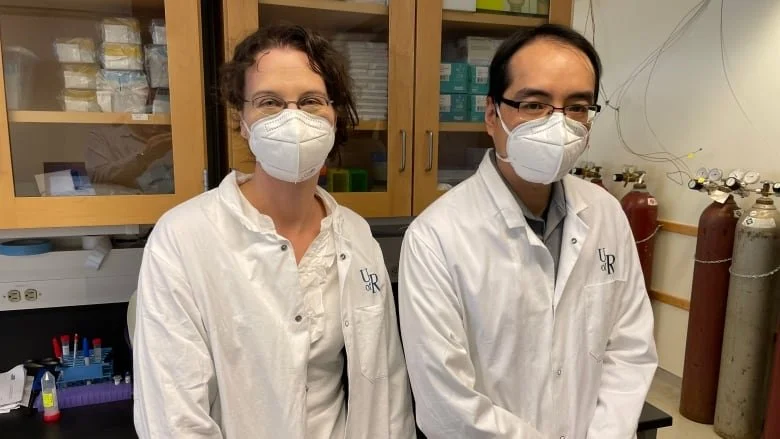
Wastewater data has proven to be useful in the management of COVID-19 in Saskatchewan. So, yes, scientists have been looking at your poop. But how does the process work? Universities, cities, and utilities providers have teamed up to share data with the public and Saskatchewan Health Authority. In Regina, two biologists head up the team that looks at these samples: Tzu-Chiao Chao, a molecular biologist and Nicole Hansmeier, a microbiologist. Both are professors at the University of Regina.
'Should be an alarm bell': Calls for action after fatal fires on First Nations
Monias Fiddler says time is moving slowly for the Sandy Lake First Nation as the community feels the immense weight from the loss of three children in a house fire last month. Grant Meekis, 9; Remi Meekis, 6; and Wilfred Fiddler, 4, died when their home was engulfed in flames on the Oji-Cree First Nation in northern Ontario. Their parents and three other siblings survived the blaze.