Federal government needs to up spending to give First Nations clean water, PBO says

Federal government needs to up spending to give First Nations clean water, PBO says

The parliamentary budget officer says the federal government would need to increase planned spending to provide clean drinking water in First Nations. Yves Giroux’s report this morning says the government has set aside enough money to build water and wastewater systems over the next five years. Where the government falls short is to help First Nations operate the systems, which Giroux’s office estimates would need $138 million more annually in federal funding.

Michigan drops Line 5 pipeline suit, refocuses on separate case

Michigan drops Line 5 pipeline suit, refocuses on separate case

Michigan Gov. Gretchen Whitmer abandoned a lawsuit Tuesday aimed at shutting down an oil pipeline that runs through part of the Great Lakes but said the state would continue pursuing a separate case with the same goal. Whitmer's legal maneuver followed a federal judge's decision earlier this month to retain jurisdiction over a suit brought by Calgary-based Enbridge Inc. after the state revoked an easement allowing Line 5 to cross the Straits of Mackinac.

Neskantaga First Nation taking Ontario to court over 'inadequate' consultation on Ring of Fire

Neskantaga First Nation taking Ontario to court over 'inadequate' consultation on Ring of Fire

Neskantaga First Nation is taking Ontario to court looking for "ground rules" on how the province should consult and accommodate Indigenous communities that are in a state of crisis. The remote Oji-Cree First Nation, located about 430 kilometres north of Thunder Bay, has been under a boil-water advisory for 26 years and a state of emergency since 2013, when seven people died by suicide in less than a year. Those issues have been compounded by the pandemic, leaving Neskantaga ill-equipped to engage in what the province has presented as consultation on a project to build a road through its territory to the mineral-rich Ring of Fire, community leaders say.

Sask. researchers continue to see downward trends in COVID-19 wastewater testing

Sask. researchers continue to see downward trends in COVID-19 wastewater testing

The most recent COVID-19 wastewater study from the University of Saskatchewan shows a drop in the amount of COVID-19 virus in sewage samples taken from Saskatoon, North Battleford and Prince Albert. The Global Institute for Water Security's report released Monday afternoon showed a decrease of 55.8 per cent in viral RNA (Ribonucleic acid) in Prince Albert's wastewater samples compared to the previous reporting period. The most recent testing period for the city was from Nov. 16 through Nov. 22.

Storm brings more rain to B.C. as officials stress need to prepare, listen to authorities

Storm brings more rain to B.C. as officials stress need to prepare, listen to authorities

The third in a series of storms that have increased in intensity is bearing down on B.C., causing major concerns for communities dealing with the consequences of previous storms over the past two weeks. CBC meteorologist Johanna Wagstaffe says 10 to 15 millimetres could fall within a mere three hours on parts of the South Coast on Tuesday, and freezing levels will rise rapidly in altitude — which means more snowmelt.

Liberal MLA for Abbotsford calls on province to help farmers restore properties, businesses

Liberal MLA for Abbotsford calls on province to help farmers restore properties, businesses

The Liberal MLA for Abbotsford South says the provincial government should be responsible for helping farmers in flood-stricken communities get back on their feet. Bruce Banman says the province failed to notify its residents, especially in floodplain areas like the Sumas Prairie, when an atmospheric river brought more than 200 millimetres of rain earlier this month. "This government was not paying attention to the Nooksack River at all and we lost 48 precious hours to be able to move equipment," Banman said on the CBC's The Early Edition.

Port aux Basques mayor says climate change talks needed after another dump of rain

Port aux Basques mayor says climate change talks needed after another dump of rain

Button says the storms, wind speeds and rainfall in his community are becoming more severe, and he says he feels it's time to have serious conversations about how communities like his can better prepare for a changing climate. Newfoundland and Labrador's government issued a statement saying no significant damage was recorded during Monday night's storm and that work to repair the highway from last week's flooding was ongoing.

Government of Canada backs innovative tech company specializing in water quality management that helps protect the environment and human health

Government of Canada backs innovative tech company specializing in water quality management that helps protect the environment and human health

Investment supports BioAlert Solutions, a growing Canadian cleantech company, and will help Canada minimize the risks of pathogens in industrial and commercial water systems. Canada's cleantech entrepreneurs are proving their power to take on today's environmental challenges. Working in partnership with innovative companies, the Government of Canada is supporting the growth of a greener economy. Today, the Honourable François-Philippe Champagne, Minister of Innovation, Science and Industry, and Élisabeth Brière, Member of Parliament for Sherbrooke, announced an investment of $900,000 in Sherbrooke-based BioAlert Solutions through Sustainable Development Technology Canada (SDTC). This is the first SDTC investment in BioAlert and part of a partnership that will help the company advance its water safety monitoring technology to minimize the risks and costs associated with Legionella contamination.

Bad weather hampers military efforts to purify Iqaluit river water

Bad weather hampers military efforts to purify Iqaluit river water

Seven weeks into Iqaluit's drinking water crisis, the Canadian Armed Forces is finalizing plans to move its water purification efforts in Iqaluit to an existing military facility, as the city's water remains unsafe to drink. The original plan, which involved using a reverse osmosis water purifier at the Sylvia Grinnell River was waylaid Nov. 22 by a winter storm that snapped the frame of a military tent that sheltered clean water bladders from the reverse osmosis system.

The Sprout: Recovering from floods will take years: B.C. farmers

The Sprout: Recovering from floods will take years: B.C. farmers

We start in British Columbia, where more heavy rainfall is expected this week and flooding shows no signs of abating. Floodwaters in the hard-hit community of Abbotsford are rising again as the Nooksack River south of the border overflows. Farmers in the region continue to assess the damage to their operations. As the Canadian Press reports, blueberry farmer David Gill says the devastating floods have set famers back by “at least a decade” and it will take them years to recover. Thousands of livestock were killed in the floods and fields across the Fraser Valley are still flooded with contaminated water. As CBC News reports, experts say it will be weeks before farmers know how the contaminated waters have affected the region’s fertile farmland.

Soaking up ideas: How ‘sponge cities’ can absorb water, prevent flooding

Soaking up ideas: How ‘sponge cities’ can absorb water, prevent flooding

As Canada grapples with the consequences of climate change, including the disastrous floods in British Columbia, cities are looking for ways to be more resilient to extreme weather. Mike Drolet looks at one idea that harnesses nature’s power to absorb water like a sponge.

More rain coming to water-drenched Cape Breton

More rain coming to water-drenched Cape Breton

David Gabriel knows his beloved Baille Ard forest dodged a bullet when last week’s storm damaged, but didn’t destroy the south end Sydney trail system. “It’s saddening, but it’s not horrific,” said Gabriel, the frontman of the Baille Ard Recreation Association. “It’s not like we haven’t been through this before and won’t go through it again. We have our smallish group of volunteers, and we’re looking for a few more to help out, and we have some equipment, so given enough decent days we can patch it up before winter so people can continue to enjoy the trail.”

Relentless rain prompts more evacuation orders as B.C. braces for 3rd consecutive storm

Relentless rain prompts more evacuation orders as B.C. braces for 3rd consecutive storm

The third in a series of increasingly intense storms is approaching British Columbia, leaving residents bracing for more torrential rain while officials are still addressing damage done across the Lower Mainland and southern Interior from the last two storms. Communities across the province were busy preparing for the latest storm during a brief reprieve from the weather in some areas Monday. Farmers rushed again to move dozens of cattle, including calves, to higher ground while residents packed sandbags around their homes.

Canada will never export bulk water to the U.S. — and journalists should stop writing about it

Canada will never export bulk water to the U.S. — and journalists should stop writing about it

This summer, environmental groups and First Nations in Clinton, B.C., a rural village of about 650, opposed a bottling company’s application to take 500,000 litres of water a day from the local aquifer. It was far from the first time that the proposed sale of water has created controversy in Canada. But it’s usually massive schemes for bulk water exports — which aren’t allowed in Canada — rather than bottled-water businesses like the one in B.C. that grab headlines. Maclean’s published high-profiles articles on the bulk-water scare in 1999 and 2000 when an Ontario businessman applied to ship water from Lake Superior to Asia.

Coal provinces ‘co-ordinated’ fight against federal water pollution rules

Coal provinces ‘co-ordinated’ fight against federal water pollution rules

Four provincial governments strategized on a “co-ordinated approach” to overhaul proposed federal regulations aimed at reducing water pollution from coal mines, according to an internal briefing note from Alberta’s environment ministry. The federal government has proposed the new regulations to reduce the harm of contaminated wastewater from coal mines on fish and fish habitat, but is behind schedule from previously announced goals and has been unable to even publish a draft version of the new rules.

Heavy rains drench British Columbians with more climate anxiety

Heavy rains drench British Columbians with more climate anxiety

As floods have ravaged through Abbotsford, B.C., Lindsay Finnson is among many locals experiencing the struggle and generosity of the community. Finnson has volunteered by sandbagging and providing food to those affected. But with more stormy weather in the forecast, the pitter-patter of rain is showering her with discomfort and anxiety. "As soon as the rain started, I just had this... tight feeling in my chest like that anxiety, right, that sense of impending doom. And like just that hope that we've done enough," she said.

A prairie hot spot for shorebirds is now a conservation site in Sask.

A prairie hot spot for shorebirds is now a conservation site in Sask.

The conservation site, called the Mackie Ranch conservation project, includes a large section of native grassland as well as part of the eastern shoreline of Chaplin Lake, a few kilometres off the Trans-Canada Highway between Moose Jaw and Swift Current, according to the NCC. Grasslands are among the most at-risk ecosystems in the world, according to the national conservation organization. They filter water, help prevent flooding as well as droughts and sequester carbon.

Ice pancakes treat Manitobans to strange formations on water

Ice pancakes treat Manitobans to strange formations on water

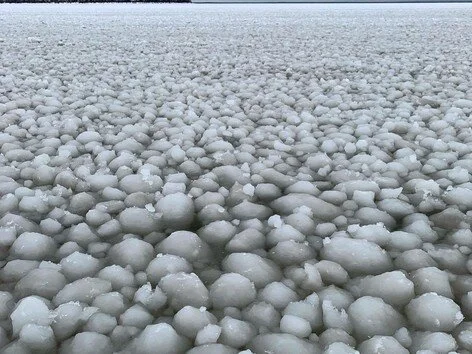
Ice pancakes and ice balls have been showing up on Lake Manitoba and Lake Winnipeg recently, treating curious Manitobans to strange ice formations with the water covered by what resembles pebbles, rocks and even pancakes. The ice anomalies were spotted last weekend at Steep Rock, Man., on the northeast shore of Lake Manitoba by local resident Peter Hofbauer, who posted photos of the phenomena on Instagram with the simple question: “Have you ever seen the lake freeze like this?”

City's plan to help Indigenous people with clean water trickling along

City's plan to help Indigenous people with clean water trickling along

A plan to improve water services to Indigenous communities has lost a little current. The proposal is to dedicate 0.2 per cent of Barrie’s water/sewer revenue next year toward Water First and its efforts to improve water services in First Nations communities. The plan would cost about $100,000, or about $1.77 for the average Barrie household in 2022. It was to be part of 2022 budget talks next week, but that will have to wait. While city staff have started consulting local First Nations groups about the donation, those talks haven’t finished at this time. Water First, a Creemore-based non-government organization (NGO), has a program to train young Indigenous people from reserves to become certified in operating a water plant through a 15-month paid apprenticeship, which is where the $100,000 would be spent.